

Wood Panel Construction: Single Piece or Glue Up?
I was talking with a potential client through email recently, and he asked a question that got me feeling a little bit giddy. The second I read the email, I imagined slapping my hands together, quickly rubbing them back and forth, and saying to myself in a child’s voice, “Oh goody!!”
We were discussing potential lid options for a humidor he was interested in commissioning, and he asked, “Is it necessary/desirable to make the lid out of two pieces of wood? Wouldn’t it be ideal to have it be a single piece with no glued seam in between?”
I occasionally get asked this question by clients commissioning custom pieces. But it takes someone with their own vision and someone with a craftsman’s mindset to even consider something like this. Let’s be serious…many people seeking out a piece of custom furniture don’t have the slightest idea what they want. They just know they don’t want a big-box store piece of furniture.
So, should a walnut panel (or any other wood panel for that matter) be one continuous piece? Or should it be two pieces glued together? Lets talk about it.
Here’s the truth: both approaches to wood panel construction have legitimate merit. However, the “best” choice depends entirely on your priorities and what you value most.
Wood Panel Construction: The Two Main Approaches
First, let’s define what we’re talking about here. Wood panel construction generally falls into two categories: single-piece panels made from one wide board, or glued panels made by joining multiple boards edge-to-edge. Single-piece wood panel construction is exactly what it sounds like. You find one wide board, mill it flat, and use it.
The alternative? A wood panel glue-up. You take two narrower boards and glue them edge-to-edge. If those boards came from the same piece (resawn down the middle), you get bookmatching. That creates a mirror-image grain pattern.
Bookmatching looks absolutely stunning when done right. In fact, it’s one of the most sought-after techniques in fine woodworking. However, it’s not your only option.
Some people prefer single-piece wood panel construction. They love the uninterrupted grain flow. Additionally, there’s something pure about knowing your lid came from one remarkable board.
Why Wood Movement Matters More Than You Think
Now let’s talk about the elephant in the room: wood movement. Wood is hygroscopic. That means it constantly absorbs and releases moisture from the surrounding air. Consequently, it swells when humidity rises and shrinks when humidity drops.
This isn’t a defect. It’s simply how wood behaves as an organic material. However, understanding this movement is critical when choosing between bookmatched wood and single-piece construction. Additionally, this is what separates the men from the boys in fine woodworking. Not accounting for wood movement will still give you a really nice piece…until next season.
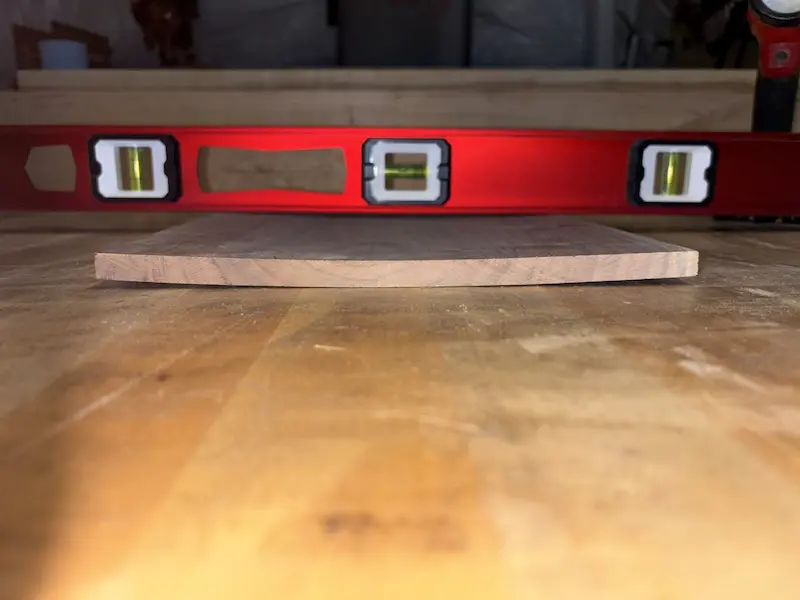
Thinner pieces of wood respond to humidity changes faster than thick pieces. Wider pieces are more prone to cupping than narrow pieces. As a result, a thin, wide board will move and warp more dramatically than a thick, narrow one.
This is exactly why finishing a piece quickly after final assembly matters so much. A proper finish seals the wood’s pores. Therefore, it dramatically slows moisture exchange. Without that protective barrier, your piece remains vulnerable to environmental changes.
Think of finish as sunscreen for wood. You wouldn’t spend all day outside unprotected. Your furniture shouldn’t either.

How Figured Wood Amplifies Movement Issues
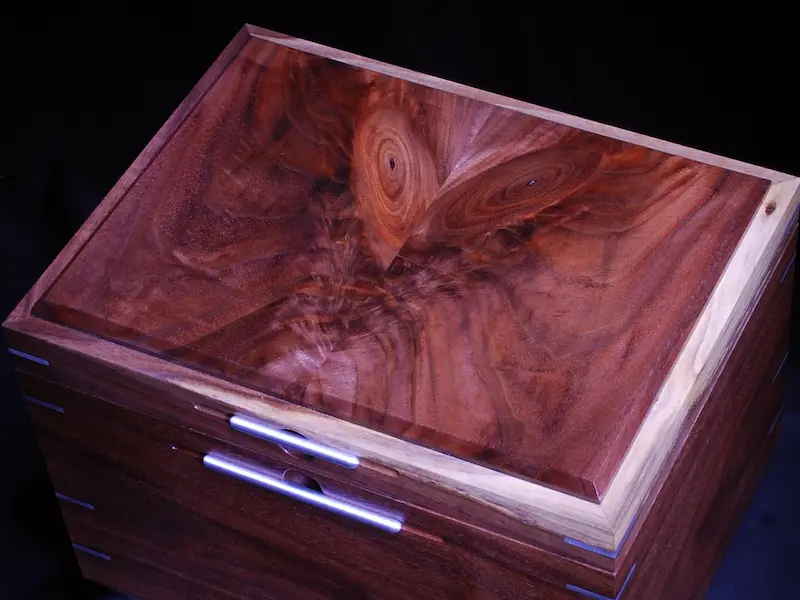
Here’s where things get interesting. Figured wood—with all those gorgeous curls, quilts, and flame patterns—amplifies every movement issue I just described. Those stunning visual effects you’re paying premium prices for? In reality, they’re actually the result of irregular grain patterns.
Let me explain. Trees naturally grow straight up toward sunlight. This creates straight, predictable grain. However, when anomalies occur, you get figuring. Branches form and disrupt vertical growth. Similarly, the tree gets injured or stressed. Additionally, environmental factors create unusual growing conditions.
All of these events cause the grain to twist, interlock, and change direction. Consequently, the wood becomes less dimensionally stable. Furthermore, it becomes significantly harder to mill and surface without tearout. I dive deeper into this in my Figured Wood blog.
I’ve had figured walnut boards that looked perfectly flat at night. Then, I’d walk into the shop the next morning and find them twisted like pretzels. So I’d flatten them again. And again. Eventually, sometimes seven or eight times later, the wood finally stabilized enough to use.
This isn’t a sign of poor craftsmanship or low-quality wood. It’s simply the nature of working with highly figured material. However, it does mean more work, more waste, and more time.
The Science Behind Resawing and Moisture Content
Let me get technical for a moment. This is important for understanding why bookmatched wood often performs differently than single-piece construction.
Imagine you have a 2-inch thick piece of lumber. Under normal storage conditions, both faces dry at roughly the same rate. As a result, the moisture content gradually equalizes throughout the board.
However, the moment you resaw that board down the middle, you expose the center—which is typically the wettest part. Now you have two pieces. Each one has a relatively dry exterior face and a much wetter freshly-cut face.
Wood naturally seeks equilibrium. It wants uniform moisture content throughout. As a result, the moisture redistributes. The wet side releases moisture. The dry side may absorb some. This redistribution causes stress within the wood fibers. Therefore, the boards begin twisting, cupping, or bowing.
This is why freshly resawn boards need additional milling. You flatten them, let them rest, and acclimate. Then flatten them again once movement has stopped. Consequently, you often lose significant thickness in the process. In my Working with Walnut blog, I show a great example of how much thickness you can lose on a highly figured piece of wood.
Here’s the critical insight: wider boards cup more readily than narrow ones. The physics are straightforward. A wider board has more surface area experiencing differential moisture exchange. Therefore, two narrow boards glued together will generally remain flatter than one wide board of equivalent total width.
Why Glue-Up Wood Panel Construction Works
So why would someone choose glued-up panels over a single piece? A few solid reasons.
Better Stability: Two narrower pieces are inherently more stable. In fact, this is why commercial furniture manufacturers almost always glue up large panels. Look closely at any mass-produced dining table. You’ll see multiple strips glued together to form that super wide Ashley Furniture dining table. And they’re not shy about it either. I once had a dining table that had 12 strips of wood all glued up to form the wood panel table top. They even glued the strips end to end. Apparently, they have no shame.
Dramatic Visuals: Bookmatched wood creates symmetrical mirror-image patterns. When you bookmatch figured walnut, the effect is mesmerizing. Furthermore, the symmetry naturally draws the eye.
Easier Sourcing: Finding a single 18-inch wide piece of figured walnut? Good luck. However, finding two 9-inch pieces with killer figure? Much easier. Therefore, glue-ups often give you better grain than single pieces would.
Less Waste: Glued wood panel construction uses lumber more efficiently. You can work around defects more easily. Additionally, you minimize the amount of prime lumber ending up in the scrap bin.


Why Single-Piece Wood Panel Construction Has Merit
Now let’s be fair to single-piece construction. There are legitimate reasons someone might prefer this approach.
Uninterrupted Flow: Some people genuinely love continuous grain flowing across an entire panel. No glue line. No seam. Just one board telling its story from edge to edge.
Simplicity: There’s something pure about single-piece wood panel construction. It feels authentic. Furthermore, some clients want to know their lid came from one remarkable tree.
Organic Character: A single wide board often contains more natural variation than bookmatched wood does. Bookmatching creates symmetry. Single pieces create unpredictability. If you prefer asymmetry, single-piece construction might align better with your aesthetic.
Bragging Rights: Let’s be honest. There’s pride in saying “that entire lid came from one board.” It demonstrates you were willing to hunt for something special.
The Sapwood Conversation
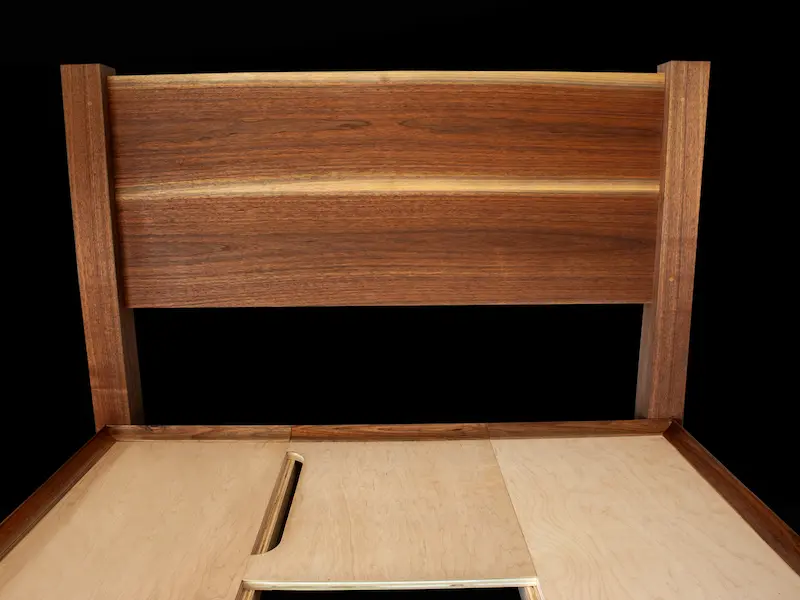
Quick sidebar on sapwood. Sapwood is that lighter, creamy outer wood on walnut boards. Some people hate it. Others love the contrast. I’m somewhere in the middle.
However, getting extremely wide walnut without any sapwood is genuinely difficult. Consequently, whether sapwood appears in wood panel construction often depends on availability.
That said, I won’t build a piece that’s predominantly sapwood. Why? Because sapwood is softer than heartwood. Additionally, most people don’t want large yellow-toned furniture.
However, a thin strip creating natural contrast? That works. In fact, it’s almost unavoidable in some projects.
Common Misconceptions About Wood Panel Construction
Let me address some myths I hear regularly about glued-up panels versus single pieces.
Myth: Bookmatched wood is “less authentic” than single pieces.
Reality: Both are authentic solid wood construction. Bookmatching is a traditional technique used by master craftsmen for centuries. There’s nothing artificial about it.
Myth: You can see the glue line in bookmatched wood.
Reality: When done properly with well-matched boards and tight joinery, the glue line is virtually invisible. Furthermore, any visible seam is overshadowed by the dramatic grain pattern.
Myth: Single pieces are always more expensive.
Reality: Sometimes yes, sometimes no. It depends on availability. I’ve seen bookmatched pairs cost more than single pieces when the figure was exceptional.
Myth: Bookmatched wood is weaker at the glue joint.
Reality: Modern wood glue is actually stronger than the wood itself. A properly glued joint will never fail. The wood around it will break first.
How Lumber Cut Affects Wood Panel Construction
Here’s something most people don’t consider: how the lumber was originally cut from the log dramatically affects stability—regardless of your wood panel construction method.
Quartersawn lumber shows the most stability. The growth rings run nearly perpendicular to the face. Therefore, it expands and contracts mostly in thickness rather than width. However, it’s also the most expensive cutting method.
Plain-sawn (or flat-sawn) lumber is most common and most affordable. However, it moves significantly more. The growth rings run parallel to the face. Consequently, it’s prone to cupping as moisture changes occur.
Rift-sawn lumber falls somewhere between quartersawn and plain-sawn in both cost and stability.
For high-end work, or when I need to have large panels, I prefer quartersawn or rift-sawn lumber when available. The increased stability justifies the premium price. However, plain-sawn lumber can work perfectly fine in bookmatched applications where narrower width provides inherent stability.

Alternative Approaches Worth Mentioning
Some builders use veneer over stable substrates like Baltic birch plywood or MDF. This completely eliminates wood movement concerns. The substrate remains dimensionally stable and the veneer provides the visual beauty. Additionally, veneer helps keep costs low. Think about it: Using a solid piece of burl to craft an entire humidor would be pretty expensive compared to using a sliver of that same burl wood glued to a piece of MDF.
It’s a legitimate approach with certain advantages. However, I prefer solid wood construction for custom work. Solid wood ages beautifully. It develops character and can be refinished decades later. I can’t tell you how many inquiries I get asking if I can refinish or refurbish grandpa’s old humidor. Most of the time, I get pictures with tell-tale signs that the box is veneer on top of a substrate. And most of the time, the dings and dents are two or three times the thickness of the veneer. Those simply can’t be refinished back to an original state without burning through the veneer.
Furthermore, solid wood construction just feels substantial in ways veneer never quite matches.
That said, I respect builders who use veneer thoughtfully. For certain applications, particularly very large panels, it makes practical sense.
What I Consider for Wood Panel Construction Projects
When evaluating construction methods, I consider several factors:
Project Scale: Smaller projects can accommodate single pieces more easily. However, larger pieces almost always benefit from glue-ups.
Client Environment: A climate-controlled Arizona home presents different challenges than a humid Louisiana basement. Further, both of those present differently, year-round, than a midwest home. Environmental stability affects how much movement you need to account for.
Timeline and Budget: Single wide pieces with premium figure cost more and take longer to source. If you have flexibility, great. If not, glue-ups often provide better value.
Long-Term Durability: I build pieces to last generations. Therefore, I prioritize structural integrity over everything else. If glue-up wood panel construction provides better stability for your application, that’s what I’ll recommend—even if you initially preferred single-piece. The construction process for building with a single piece versus glued-up wood panel differs slightly. However, in terms of box lids, neither option is better or worse than the other.
So Which Should You Choose?
Here’s my honest take on wood panel construction choices. Don’t let anyone tell you one approach is definitively superior. It’s not.
What matters most is understanding the tradeoffs. You need to make an informed decision based on your priorities. Additionally, you need a builder who executes it with skill and attention to detail.
Because at the end of the day, construction method matters less than craftsmanship. A poorly executed bookmatched panel looks terrible. A beautifully crafted single piece looks amazing. And vice versa.
Focus on finding a builder who understands wood movement. Someone who selects premium materials. Someone who takes pride in their joinery. The rest is just details.
If you’re planning a custom piece, have an honest conversation with your builder about wood panel construction options. A good builder explains the pros and cons specific to your project. Furthermore, they help you navigate the decision without pushing their preferred method.
Ask to see examples of both approaches. Look at how bookmatching creates symmetry. Examine how single pieces showcase organic variation. Trust your gut reaction.
Remember: you’re not just buying furniture. You’re commissioning something that should outlast both of us. Something built with intention, skill, and care.
That’s worth getting right.
Making Your Decision: Key Questions to Ask
Ready to choose between bookmatched wood and single-piece construction? Consider these questions:
What matters most aesthetically? Symmetrical drama or organic flow?
How important is long-term stability? Will this piece see significant humidity changes with the seasons?
What’s your timeline? Can you wait for the perfect single board to surface?
What’s your budget? Are you comfortable with premium pricing for rare wide boards?
How do you feel about natural variation? Do you want sapwood, knots, and color variation? Or consistent appearance?
What’s the piece’s function? Will it see heavy use or remain primarily decorative?
These questions don’t have right or wrong answers. However, they’ll clarify what approach aligns best with your vision and priorities.
The Bottom Line on Wood Panel Construction
Here’s what I want you to take away from this. Single piece or glued-up panels? Both create stunning results when executed properly. The “better” choice is entirely subjective and situation-dependent.
Don’t let anyone tell you one approach is definitively superior. It’s not. Professional builders use both techniques depending on the specific project requirements.
What matters most is that you understand the tradeoffs in wood panel construction. That you make an informed decision based on your priorities. And that whoever builds your piece executes it with skill and attention to detail.
Because at the end of the day, the construction method matters less than the craftsmanship behind it. A poorly executed bookmatched panel looks terrible. A beautifully crafted single piece looks amazing. And vice versa.
Focus on finding a builder who understands wood movement, selects premium materials, and takes pride in their joinery. If the builder’s first response to your inquiry is just a quote for the job, expect that they just want to sell you something and don’t really give a rat’s ass about precision or building you exactly what you envision.
Moving Forward With Your Project
If you’re planning a custom piece, have an honest conversation with your builder about these options. A good builder will explain the pros and cons specific to your project. Furthermore, they’ll help you navigate the decision without pushing you toward their preferred method.
Ask to see examples of both approaches. Look at how bookmatched wood creates symmetry. Examine how single pieces showcase organic variation. Trust your gut reaction.
Remember: you’re not just buying furniture. You’re commissioning something that should outlast both of us. It is something that tells your story. And it’s something built with intention, skill, and care.
That’s worth getting right.
Ready to start your custom project? Let’s talk through your options and create something truly exceptional together.